


the "perfect son" syndrome : a classical psychodynamic interpretation of butch lesbian identity
- Martin Döhring

- 16. Apr.
- 3 Min. Lesezeit
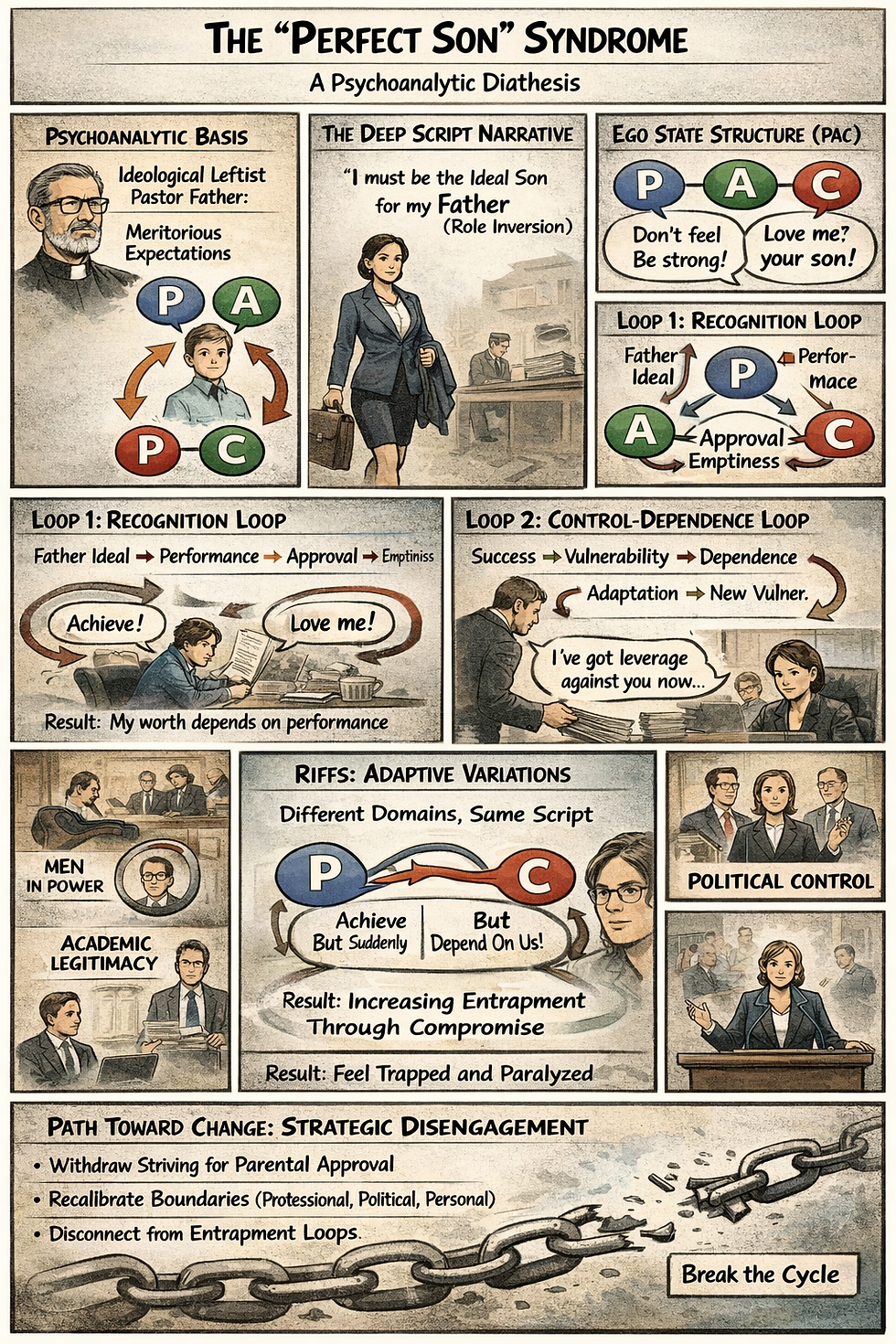
Freudian and Transactional-Analytic Hypotheses on Early Development, Identification, and Gender Expression
1. Preliminary Clarification
From the standpoint of modern psychology:
lesbian orientation is not considered pathological
butch/femme expressions are not symptoms
there is no accepted psychodynamic “cause”
However, in the traditions of Sigmund Freud and later ego-state models like Eric Berne, one may formulate developmental hypotheses about how masculine identification patterns in women emerge.
These are interpretive narratives, not empirical proofs.
2. Freud: Identification and the Oedipal Configuration
In Freudian theory, early childhood involves:
attachment to the mother
differentiation from the mother
identification with same-sex parent
development of object choice
Freud assumed that a girl:
begins attached to the mother
shifts libidinal attachment toward the father
identifies with the mother
This is the classic feminine Oedipal pathway.
A deviation from this sequence was historically interpreted as the basis for lesbian object choice.
3. Freudian Thesis: Strong Father Identification
One classical Freudian hypothesis would be:
A girl develops strong identification with masculine power, often through idealization of the father or devaluation of the mother.
Possible dynamics:
father experienced as powerful, autonomous, admired
mother experienced as weak, passive, intrusive, or rejecting
child adopts masculine identification as defense and aspiration
This yields:
masculine ego-identification
preference for active role
erotic orientation toward women
In classical Freudian terms:
The subject identifies with the masculine position and chooses women as love objects.
This is the historical psychoanalytic explanation.
4. Defensive Masculinization Hypothesis
A more conflict-oriented Freudian reading:
If the mother is experienced as:
engulfing
unreliable
humiliating
the girl may defensively reject “femininity,” because femininity is unconsciously linked to vulnerability.
Thus:
masculinity becomes a defensive structure against dependency.
In that model, “butch” identity would represent:
autonomy
agency
invulnerability
The psychodynamic meaning:
“I will become the strong one rather than the dependent one.”
This is not about orientation itself, but about gendered defensive organization.
5. Eric Berne: Ego States and Script Formation
Eric Berne would not explain lesbian orientation biologically, but in terms of script decisions.
A child forms script beliefs such as:
“women are weak”
“men have power”
“to survive I must be strong”
“dependency is dangerous”
These script conclusions shape ego-state patterns.
6. PAC Interpretation of Butch Gender Style
Parent Ego
Internalized messages:
“Never be weak”
“Don’t be soft”
“Control emotions”
Adult Ego
Reality strategy:
competence
independence
rational dominance
Child Ego
Adaptation:
suppression of vulnerable dependency needs
defensive toughness
This yields a personality organization where:
the Critical Parent + Adapted Child alliance produces a “strong masculine presentation.”
The person may unconsciously decide:
“To be safe, I must occupy the powerful role.”
7. TA Script Thesis
Within TA one could formulate:
A butch identity style may represent a life script organized around power, autonomy, and protection against dependency, especially where femininity is associated with danger or humiliation.
This script might include injunctions such as:
“Don’t be a girl”
“Don’t need”
“Don’t depend”
“Be strong”
These shape gender role expression, not necessarily orientation itself.
8. Important Distinction: Orientation vs. Style
This distinction is essential:
Sexual Orientation
attraction to women
not explained by trauma models
not reducible to psychodynamics
Gender Style
butch, femme, androgynous
may reflect identification patterns
may carry defensive meaning
Thus psychodynamic theories may speculate about butch style, but cannot explain lesbian orientation itself.
9. Modern Critical Evaluation
Modern psychology rejects the idea that lesbian identity is “caused” by:
maternal deficits
father identification
childhood trauma alone
There is no evidence that lesbian women are:
developmentally arrested
masculinity-defended
psychodynamically “deviant”
These were historical psychoanalytic narratives, often shaped by heteronormative assumptions.
So the modern critique is:
Freud offers symbolic interpretations, but not causal science.
10. Final Thesis
If one were to formulate a strict psychodynamic thesis in Freudian/TA language, it would be:
A butch lesbian identity may be interpreted as a developmental organization in which masculine identification becomes associated with safety, agency, and autonomy, while femininity becomes linked with dependency or vulnerability; this structure is then reinforced through script decisions favoring strength, control, and identification with the active role.
But it must be stressed:
This may explain aspects of gender presentation—not lesbian orientation itself.


Kommentare