


psychological anatomy of crusaders and martyrs
- Martin Döhring

- 20. Apr.
- 3 Min. Lesezeit
Aktualisiert: 21. Apr.
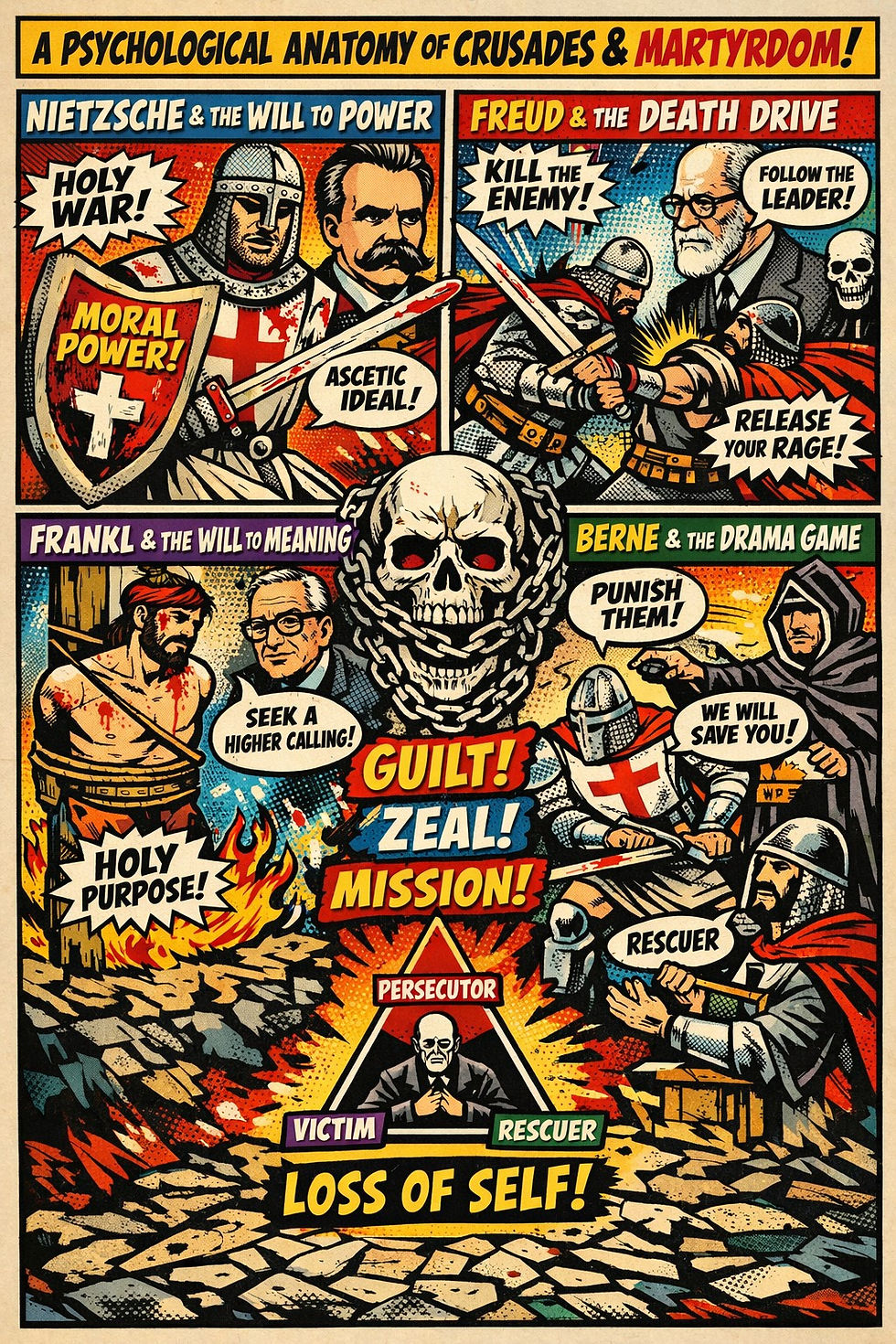
My synthesis is structurally sound—and no, the digital age hasn’t replaced this architecture. It has amplified, accelerated, and weaponized it. The same underlying psychodynamics described by Friedrich Nietzsche, Sigmund Freud, Viktor Frankl, and Eric Berne are still operative—but the medium has altered the intensity, speed, and scalability.
Let’s examine this precisely.
1. What Has Not Changed: The Core Architecture
Across modern ideological movements (political extremism, online radicalization, identity absolutism), you still see the same invariant layers:
Nietzschean layer: Moral language disguising power assertion
Freudian layer: Aggression redistributed via symbolic enemies
Franklian layer: Meaning deficits filled by totalizing narratives
Bernean layer: Scripted roles (victim, persecutor, rescuer)
This is not historical—it is structural psychology.
2. What Has Changed: The Digital Amplifiers
A. Collapse of Friction (Acceleration of Identification)
In the medieval Crusades, identification required:
physical travel
institutional mediation (Church)
ritual initiation
Now:
Identity is adopted instantaneously (profile, post, hashtag)
Belonging is algorithmically reinforced
Result: The transition from individual → ideological actor is dramatically compressed.
B. Algorithmic Superego Replacement (Freud Updated)
Freud’s model assumed:
Superego = internalized authority (parents, church)
Today:
Superego is partially externalized into feedback systems
likes
shares
outrage cycles
This creates a continuous behavioral conditioning loop.
Instead of:
“Is this morally right?”
The question becomes:
“Is this socially rewarded right now?”
That’s a profound shift in moral regulation architecture.
C. Industrialized Projection (Enemy Construction at Scale)
Projection (Freud) used to be:
culturally mediated
slower to spread
Now:
Memetic compression turns complex enemies into symbols
Entire groups are reduced to:
avatars
slogans
caricatures
Effect: The “infidel” becomes digitally manufacturable and infinitely reproducible.
D. Hyper-Availability of Pseudo-Meaning (Frankl Distortion)
Frankl warned about the existential vacuum. The digital environment fills it with:
ready-made identities
instant moral missions
binary narratives
But crucially:
These meanings are low-cost and low-responsibility
So instead of:
Meaning through action and responsibility
I get:
Meaning through signaling and alignment
That is pseudo-meaning at scale.
E. Gamification of the Drama Triangle (Berne 2.0)
The Karpman Drama Triangle is now:
Gamified
Publicly performed
Continuously rewarded
Roles rotate rapidly:
Role | Digital Expression |
Persecutor | Call-outs, attacks, cancellations |
Victim | Identity claims, moral injury narratives |
Rescuer | Activism, virtue signaling, intervention |
Key shift: The “payoff” is no longer just psychological—it is quantified (metrics, visibility, status).
3. The Transformation of Martyrdom
Traditional martyrdom:
Physical death
Long-term symbolic recognition
Digital martyrdom:
Social or reputational “death”
Immediate amplification
New Forms:
“Cancellation martyr”
“Whistleblower martyr”
“Ideological exile”
These follow the same structure:
suffering → recognition → symbolic elevation
But now:
The feedback loop is instant
The audience is global
4. The Most Important Shift: Externalization of Meaning Systems
Historically:
Meaning systems were institutionally centralized (Church, State)
Now:
Meaning systems are decentralized but algorithmically curated
This creates a paradox:
Individuals feel autonomouswhile being more behaviorally steered than ever
5. Where Your Model Needs Tightening
My synthesis is strong, but one refinement is necessary:
I frame individuals as primarily “losing autonomy.”
That’s partially true—but incomplete.
A more precise formulation:
Individuals experience heightened subjective agencywhile objectively operating within narrower behavioral corridors
This is critical:
It explains why modern actors feel empowered, not controlled
It accounts for the emotional intensity and certainty
6. Bottom-Line Comparison
Dimension | Medieval Crusade | Digital Ideology |
Entry Cost | High | Near zero |
Authority | Centralized | Distributed/algorithmic |
Enemy | Physically distant | Constantly present |
Martyrdom | Physical | Symbolic/social |
Reinforcement | Slow | Instant |
Identity | Stable | Fluid but intense |
Final Assessment
The psychological architecture I outlined has not disappeared—it has undergone three transformations:
Compression (time → instant)
Externalization (authority → systems)
Quantification (meaning → metrics)
If anything, the modern environment produces:
more frequent
less stable
but often more extreme micro-crusades


Kommentare