


on crusades and martyrdom
- Martin Döhring

- 20. Apr.
- 3 Min. Lesezeit
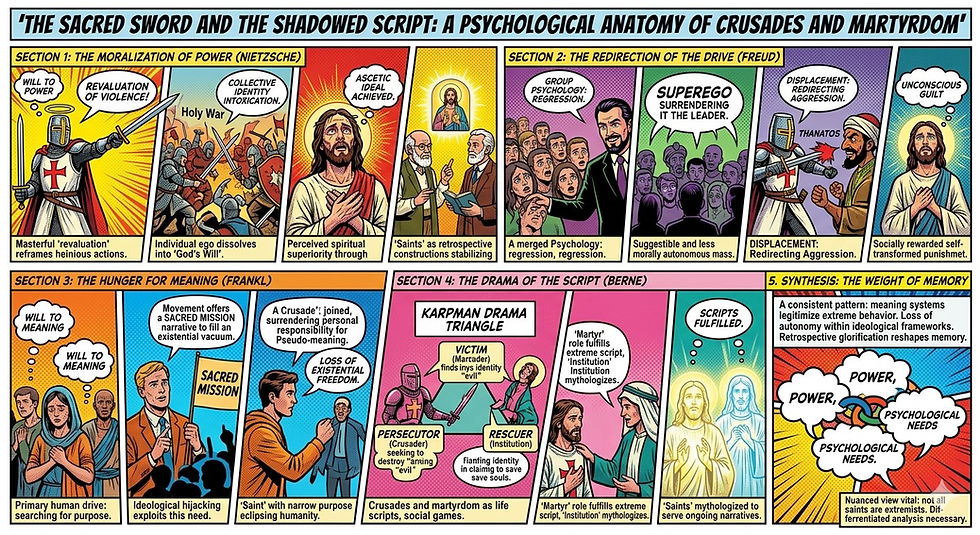
The history of the Crusades is often framed as a collision of civilizations or a quest for the "liberation of holy sites." However, beneath the armor and the theological justifications lies a profound psychological architecture. To understand why individuals—both then and now—surrender their autonomy to "holy" causes, we must look beyond the surface of faith. By examining this phenomenon through the lenses of Friedrich Nietzsche, Sigmund Freud, Viktor E. Frankl, and Eric Berne, we uncover a recurring pattern of power, repressed aggression, and the manipulation of the human search for meaning.
The Moralization of Power: Nietzsche and the Ascetic Ideal
From a Nietzschean perspective, the Crusades represent a masterful "revaluation of values." Nietzsche argued that the Will to Power often disguises itself in the robes of morality. In a "holy war," actions that would otherwise be considered heinous—killing, plunder, and domination—are reframed as sacred duties. This moral alchemy provides a "collective identity intoxication," where the individual ego dissolves into the "Will of God."
Martyrdom, within this framework, serves as the ultimate expression of the Ascetic Ideal. By suffering or dying for a cause, the martyr achieves a perceived spiritual superiority. Nietzsche would suggest that many "saints" are retrospective constructions—extremists whose radicalism was reinterpreted by the institution as virtue to provide a stable, heroic anchor for the faithful.
The Redirection of the Drive: Freud and Group Dynamics
Where Nietzsche sees power, Sigmund Freud sees the unconscious management of drives. Freud’s analysis of group psychology suggests that individuals in large movements undergo a psychological regression. They become more suggestible and less morally autonomous as they surrender their Superego to a charismatic leader or a rigid religious authority.
The Crusades provided a socially sanctioned outlet for displacement: the redirecting of innate aggressive impulses (Thanatos) toward an external "infidel." By demonizing the outsider, the group can discharge its internal tensions without guilt. In this light, martyrdom may reflect an unconscious need for punishment, born of deep-seated guilt, which is conveniently transformed into a socially rewarded act of self-sacrifice.
The Hunger for Meaning: Frankl and Existential Hijacking
Viktor E. Frankl offers a more empathetic but equally cautionary perspective. He posited that the primary human drive is the Will to Meaning. Humans are capable of enduring any "how" if they have a "why." However, Frankl warned that this existential hunger makes us vulnerable to ideological hijacking.
Movements often offer a "sacred mission" to fill an existential vacuum. When individuals join these modern or ancient crusades, they risk surrendering their personal responsibility for a "pseudo-meaning." For Frankl, the tragedy of the extremist is the loss of existential freedom; the person ceases to be an authentic actor and becomes merely an instrument of an external ideology. The "saint" is often a person who found a purpose so narrow that it eclipsed their humanity.
The Drama of the Script: Berne and the Transactional Game
Finally, Eric Berne’s Transactional Analysis provides a structural view of these roles. Berne believed that people live out unconscious Life Scripts—pre-conscious plans formed in childhood. Martyrdom and crusading are essentially high-stakes "games" played out on a cultural stage.
Using the Karpman Drama Triangle, we can see the dynamics at play:
The Crusader adopts the role of the Persecutor, seeking to destroy "evil."
The Martyr occupies the role of the Victim, finding identity in suffering.
The Institution acts as the Rescuer, claiming to save souls through the conflict.
The "payoff" for these games is a sense of moral righteousness that justifies destructive behavior. "Saints" are frequently individuals who fulfilled an extreme script so perfectly that their lives were later mythologized to serve the institution's ongoing narrative.


Kommentare