


freudian recognition of trial and order
- Martin Döhring
- 6. Mai
- 3 Min. Lesezeit
Aktualisiert: 7. Mai
Freud in a Basquiat Courtroom: Trials as Psychic Theatre
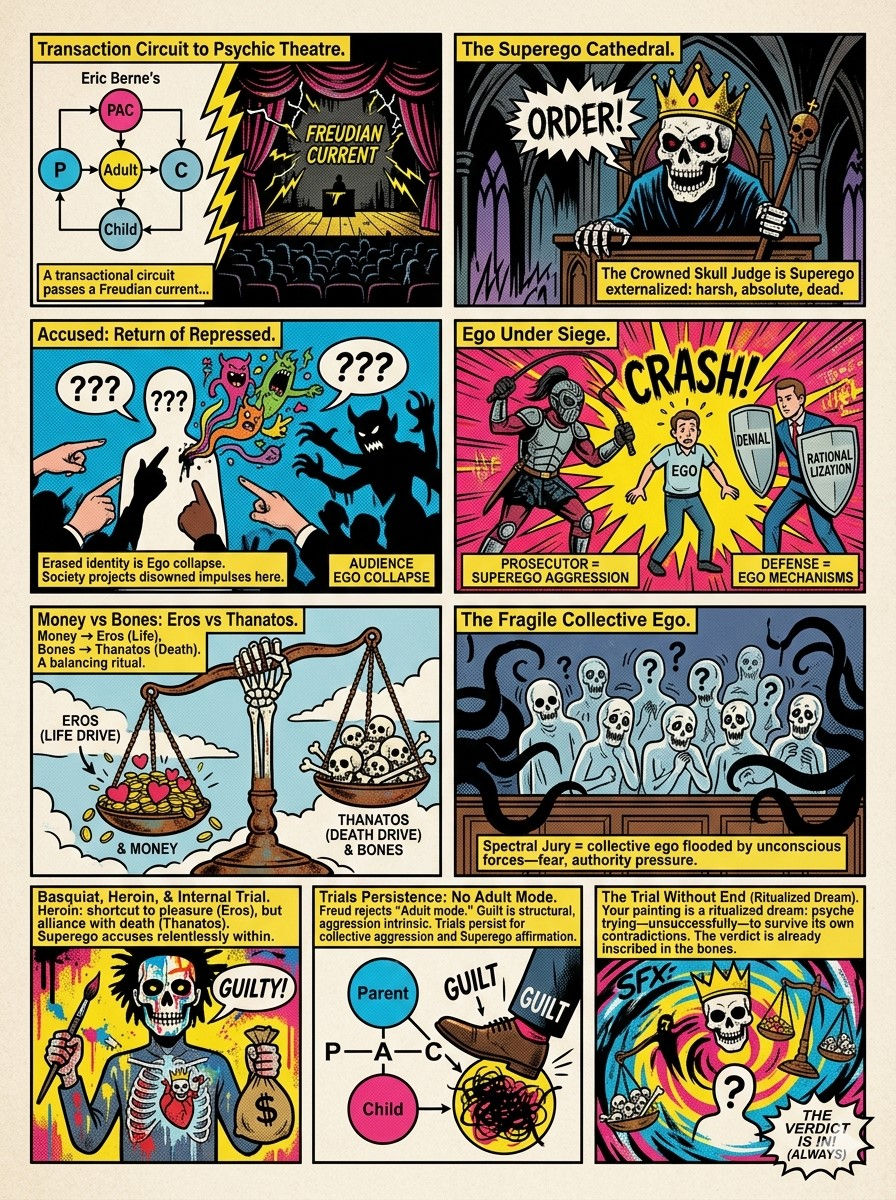
-> What I’ve built with Dr Eric Berne is a transactional circuit. If we now pass a Freudian current through it, the courtroom stops being a “game” and becomes a stage for unconscious conflict — a ritual where society manages guilt, aggression, and forbidden desire.
I. The Court as Superego Cathedral
For Sigmund Freud, a trial is not primarily about truth-finding. It is a collective enactment of the superego—the internalized law that punishes the ego for its transgressions.
Your crowned skull judge shouting “ORDER” is the superego externalized: harsh, absolute, and strangely dead (a skull enforcing life).
The ritual language, robes, and hierarchy resemble what Freud would call a civilized substitute for primal authority—the father who once set limits.
In Freud’s frame, the court doesn’t discover guilt; it produces and organizes it.
II. The Accused: Return of the Repressed
The figure marked “???” is textbook Freudian material.
The erased identity signals the collapse of the ego under pressure.
What stands trial is not just an act, but the return of repressed drives—aggression, sexuality, taboo impulses.
Freud would insist: the accused is disturbing not because he is different, but because he is recognizable. He carries what everyone else has pushed into the unconscious.
The courtroom thus becomes a projection chamber:
Society places its own disowned impulses onto one body—and punishes it there.
III. Prosecutor and Defense: Ego Under Siege
Where Berne sees Parent vs. Child, Freud sees ego caught between forces:
The Prosecutor = superego aggression, moral sadism disguised as justice.
The Defense = ego defense mechanisms: rationalization, denial, intellectualization.
There is no stable rational ground because the ego is structurally outmatched. It is trying to negotiate between:
instinct (id),
punishment (superego),
and reality (which gets drowned in noise, just as in your painting).
IV. The Scales: Money vs. Bones → Eros vs. Thanatos
Your image of “Money vs. Bones” maps almost perfectly onto Freud’s late theory:
Money → Eros (life drive, accumulation, preservation, libido in social form)
Bones → Thanatos (death drive, decay, reduction to zero)
A trial, then, is a balancing ritual between:
the urge to sustain life and order, and
the equally powerful urge toward destruction and punishment.
Freud would be blunt: punishment satisfies something. It is not purely rational—it is libidinally charged.
V. The Jury: Fragile Ego of the Collective
Your ghost-like jury is the closest thing to Freud’s reality principle—but weakened.
Ideally: the jury = collective ego, weighing evidence.
In reality: it is flooded by unconscious forces—fear, identification, authority pressure.
Freud repeatedly showed that groups regress psychologically. So your spectral jury is accurate: it is an ego that has lost solidity, drifting in the noise of drives and authority.
VI. Basquiat, Heroin, and the Trial Without End
Now bring in Jean-Michel Basquiat and heroin—not as biography alone, but as symbolic logic.
Heroin, in Freudian terms, is:
a chemical shortcut to pleasure (Eros),
but also a slow alliance with death (Thanatos).
Basquiat’s skeletal figures already look like they are post-verdict—as if judgment has already happened, internally.
Here’s the crucial Freudian inversion:
The real trial is not in the courtroom. It is inside the subject.
The superego accuses relentlessly.
The ego defends weakly.
The id keeps generating forbidden impulses.
Heroin becomes an attempted exit from the trial—a way to silence the superego and dissolve conflict. But the price is that it collapses the entire psychic structure.
So the Basquiat courtroom is not just legal critique. It is:
a mind under prosecution,
where the verdict is already inscribed in the bones.
VII. Why Trials Feel Inevitable (Freud’s Dark Insight)
Freud would ultimately reject the hope that you can simply “switch to Adult mode” (as Berne proposes).
Because:
guilt is structural, not situational,
aggression is intrinsic, not accidental.
Trials persist because they serve deep functions:
they channel collective aggression,
they reaffirm the authority of the superego,
they provide a socially sanctioned form of punishment-as-satisfaction.
Final Compression (Freudian Reading of the Image)
The painting is a ritualized dream:
The Judge = superego, crowned and dead
The Accused = repressed self, exposed
The Lawyers = ego defenses collapsing
The Jury = fragile reality principle
The Scales = life vs. death drives
The Noise = unconscious overflow
And Basquiat—moving through heroin and paint—becomes both:
the defendant,
and the court itself.
Not a system seeking truth, but a psyche trying—unsuccessfully—to survive its own contradictions.


Kommentare