


AI Data Center with Deep Geothermal Power Supply

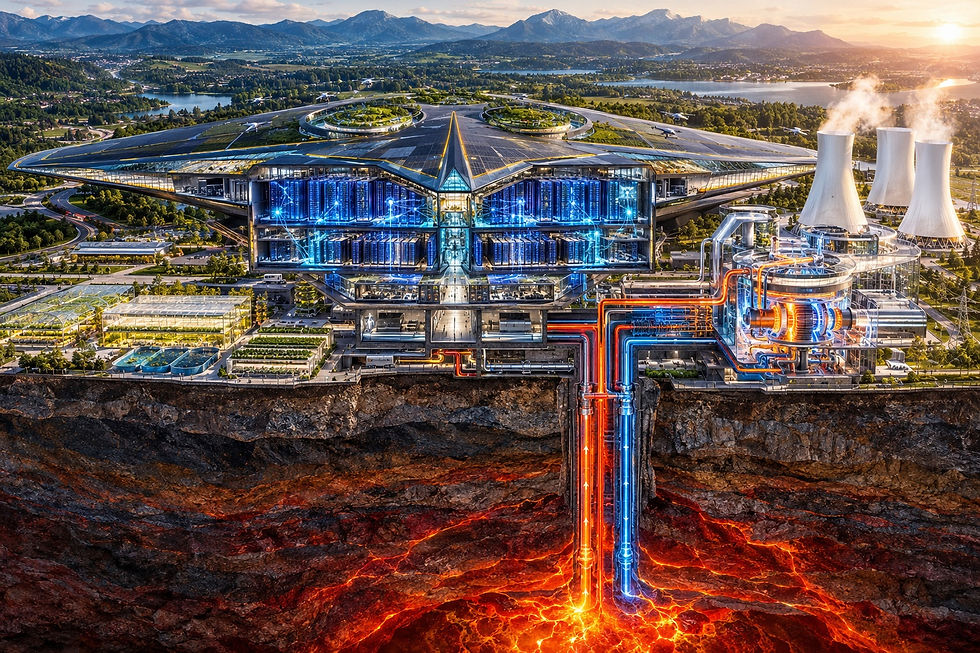
Integrated Geothermal Energy, High-Performance Computing and Heat-Recovery Campus
The drawing presents a visionary integrated energy and computing campus in which a high-performance AI data center is directly coupled to a deep-geothermal energy system. The concept combines high-density GPU computing, geothermal electricity generation, liquid cooling, energy storage, heat recovery and agricultural applications into a single industrial ecosystem.
The central idea is to create an energy-and-computing closed loop: geothermal heat provides electricity and thermal energy; electricity powers the AI infrastructure; the AI servers generate substantial waste heat; and this heat is subsequently recovered for additional applications such as greenhouses, aquaculture, district heating or industrial processes.
1. Deep Geothermal Wells
The most important energy infrastructure is located beneath the facility.
Two deep wells form a geothermal production-and-injection system:
Red pipeline – geothermal production flow: hot water/steam rises from the deep reservoir.
Blue pipeline – injection/return flow: cooled geothermal fluid is returned underground.
The illustrated well depth is approximately 3,000–5,000 m, depending on the geological setting.
The geothermal reservoir is represented as a hot permeable rock formation deep underground.
The drawing indicates geothermal fluids of approximately 200–280 °C.
In an actual project, the reservoir would normally not be described simply as a "magma layer." The useful geothermal heat is generally extracted from hot rock and circulating geothermal fluids, while magma may provide the ultimate geological heat source at greater depth.
The system could be designed as either:
hydrothermal geothermal generationor, where natural permeability is insufficient, an Enhanced Geothermal System (EGS).
2. Geothermal Power Plant
The geothermal power plant is located to the right of the data center.
The sequence is approximately:
Geothermal reservoir → production well → heat/steam system → turbine → generator → transformer → data center
The hot geothermal fluid transfers thermal energy to the power-generation cycle.
Depending on the temperature and chemistry of the resource, several technologies are possible:
Flash-steam system
High-temperature geothermal water is depressurized, producing steam that drives a turbine.
Binary-cycle system
The geothermal fluid heats a separate working fluid with a lower boiling point. The secondary vapor drives the turbine.
For a resource around 200 °C, a binary-cycle or flash/binary configuration could be considered depending on reservoir conditions.
3. Turbine and Generator
The steam turbine converts thermal energy into mechanical rotational energy.
The turbine shaft drives an electrical generator:
thermal energy → mechanical energy → electrical energy
The generator produces electricity for:
GPU clusters
CPUs
networking equipment
cooling pumps
chillers
lighting
control systems
battery charging
auxiliary infrastructure
A transformer then raises or adjusts the voltage for distribution throughout the campus.
4. Condenser and Cooling System
After passing through the turbine, the working fluid must be condensed.
The drawing therefore shows a condenser and cooling-water circuit.
The cooling system removes the remaining low-grade heat from the power-generation process.
Possible real-world configurations include:
cooling towers
dry coolers
air-cooled condensers
cooling ponds
hybrid wet/dry cooling systems
The choice would depend strongly on water availability, climate and environmental constraints.
5. AI Data Center
The main building is the AI computing facility.
Its interior is divided into several functional zones.
GPU server halls
The drawing shows multiple rows of high-density server racks.
These could contain:
GPU accelerators
CPU systems
high-bandwidth memory
NVMe storage
AI networking equipment
optical interconnects
high-speed InfiniBand/Ethernet fabrics
The facility is therefore conceived primarily as a high-performance computing (HPC) and AI training/inference center rather than a conventional office-oriented data center.
6. High-Density GPU Clusters
The GPU racks represent the computational heart of the installation.
A modern AI cluster can contain thousands or potentially tens of thousands of accelerators.
The architecture could support:
large language models
multimodal AI
scientific simulation
digital twins
robotics
autonomous systems
computational biology
weather and climate modelling
generative AI
large-scale inference
The major engineering challenge is that GPUs convert a very large proportion of their electrical input into heat.
Consequently, the cooling system becomes almost as important as the electrical system.
7. Liquid Cooling
The drawing indicates an integrated cooling infrastructure.
For extremely high-density AI racks, direct-to-chip liquid cooling is increasingly attractive.
Instead of relying exclusively on room air conditioning, coolant can circulate directly through cold plates attached to:
GPUs
CPUs
accelerators
A simplified thermal chain is:
GPU → cold plate → coolant → heat exchanger → heat-recovery system
This makes it possible to capture the server heat at a relatively useful temperature.
8. Waste-Heat Recovery
One of the most interesting aspects of the concept is that the AI data center is not treated merely as a consumer of electricity.
It becomes a heat-producing industrial facility.
The energy chain can therefore be:
Geothermal heat → electricity → AI computation → waste heat → useful thermal energy
Instead of releasing all of this heat into the atmosphere, it could be recovered.
Potential applications include:
district heating
greenhouses
aquaculture
agricultural drying
hot-water production
industrial process heat
absorption cooling
This creates a cascaded energy system.
9. Greenhouses and Aquaculture
The agricultural facilities shown adjacent to the data center represent a possible second stage of the energy cascade.
Recovered heat could maintain greenhouse temperatures during cold periods.
Aquaculture systems could use controlled-temperature water for fish or other biological production.
The concept therefore combines three industrial domains:
Energy + Computing + Food Production
This is considerably more efficient than treating the data center, power plant and agricultural facility as isolated systems.
10. Battery Energy Storage
The drawing also shows a battery storage system between the power plant and the data center.
The battery can provide several functions:
short-term power balancing
peak shaving
backup power
voltage stabilization
grid services
smoothing of variable renewable generation
black-start support
It could also allow the data center to temporarily operate at reduced grid demand.
For a mission-critical AI facility, however, batteries would normally be only one layer of the electrical resilience architecture. UPS systems, generators or other backup technologies may also be required.
11. High-Voltage Electrical Infrastructure
The generated electricity passes through electrical switchgear and transformers before reaching the data center.
A simplified electrical architecture is:
Geothermal generator↓Generator switchgear↓Transformer↓Medium/high-voltage distribution↓Data-center electrical rooms↓UPS / power distribution units↓GPU racks
This infrastructure is essential because a large AI data center can represent a very substantial continuous electrical load.
12. Control Center and Network Infrastructure
The upper section of the data center contains the control and network infrastructure.
This could include:
Network Operations Center (NOC)
Security Operations Center (SOC)
electrical control systems
cooling-control systems
building-management systems
geothermal plant control
AI cluster management
fiber-optic networking
redundant network switches
monitoring and telemetry
In a fully integrated campus, the computing infrastructure and energy infrastructure could be coordinated by a common energy-management and AI orchestration system.
13. AI-Controlled Energy Management
A more advanced version of the concept could introduce an intelligent control layer.
The AI system could continuously optimize:
electricity production ↔ computing load ↔ cooling ↔ battery storage ↔ heat recovery
For example, the system could dynamically determine:
when GPU workloads should be increased
when batteries should charge
when batteries should discharge
how much geothermal generation is required
optimal coolant temperatures
how much waste heat can be recovered
whether surplus electricity should be exported to the grid
This transforms the facility into an energy-computing cybernetic system.
14. Thermal Energy Cascade
The complete thermal architecture could be represented as:
GEOTHERMAL RESERVOIR
        ↓
DEEP PRODUCTION WELL
        ↓
HOT GEOTHERMAL FLUID
        ↓
POWER GENERATION
        ↓
ELECTRICITY
        ↓
AI GPU CLUSTERS
        ↓
COMPUTATIONAL WASTE HEAT
        ↓
LIQUID COOLING
        ↓
HEAT EXCHANGER
        ↓
USEFUL HEAT
   ↙     ↓      ↘
GREENHOUSES  AQUACULTURE  DISTRICT HEATING
The crucial principle is energy cascading: high-grade energy is used first for electricity production and computation, while lower-grade thermal energy is subsequently used for heating and biological production.
15. The Data Center as an Artificial Metabolism
Architecturally, the entire facility can be understood almost like a technological organism.
Biological analogy | Infrastructure |
Roots | Geothermal wells |
Blood circulation | Cooling and geothermal pipelines |
Heart | Geothermal power plant |
Brain | AI/GPU cluster |
Nervous system | Data network |
Metabolism | Energy conversion |
Heat regulation | Cooling system |
Digestive/recycling system | Heat recovery |
External environment | Electrical grid and ecosystem |
This makes the design more than simply a data center.
It is an integrated cybernetic energy system.
16. Key Engineering Parameters for a Real Project
For an actual engineering design, the conceptual drawing would ultimately need to specify at least:
geothermal reservoir temperature
reservoir permeability
well depth
production flow rate
injection flow rate
geothermal fluid chemistry
expected thermal power
electrical generation capacity
GPU electrical load
rack power density
cooling-water/coolant flow
heat-recovery temperature
battery capacity
transformer capacity
grid connection
redundancy level
PUE (Power Usage Effectiveness)
water consumption
seismic constraints
environmental impact
emergency power requirements
One particularly important parameter would be PUE. A highly optimized AI data center might aim for a very low PUE, because every additional unit of energy consumed by cooling, power conversion and auxiliary infrastructure reduces the amount available for actual computation.
17. Overall Concept
The architectural vision can therefore be summarized as:
A geothermal-powered AI campus in which the Earth's deep thermal energy is converted into electricity, electricity is transformed into computational intelligence, and the resulting waste heat is returned to the productive economy.
The facility consequently forms a closed technological chain:
EARTH → HEAT → ELECTRICITY → COMPUTATION → HEAT → FOOD / HEATING / INDUSTRY
That is the strongest idea contained in your construction drawing: the AI data center is not merely attached to a power plant; energy production, computation, cooling and heat utilization are designed as one integrated system.


Kommentare