


Woman in Yellow
- Martin Döhring

- 21. Apr.
- 3 Min. Lesezeit
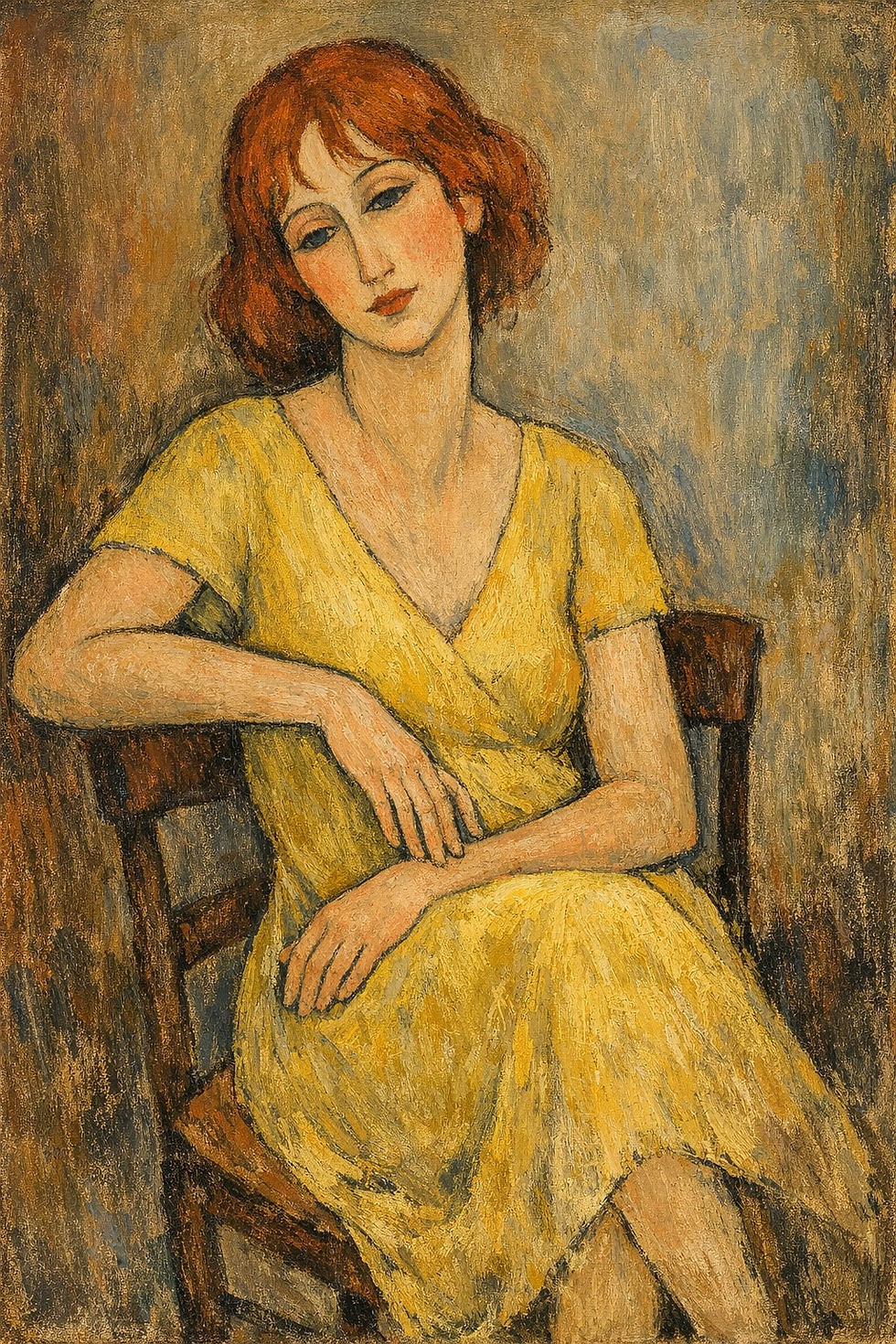
The provided interpretation offers a profound journey into the psyche, transforming a canvas of oil and pigment into a mirror of the human soul. By blending the analytical depth of Carl Jung with the structural clarity of Eric Berne, we can view this portrait not just as a likeness of a woman, but as a map of internal architecture.
The Woman in Yellow: An Allegory of the Soul
This painting, characterized by the signature elongated elegance and melancholic grace of the Modigliani style, serves as a perfect vessel for symbolic interpretation. Through a psychological lens, the woman in the vibrant yellow dress ceases to be a literal sitter and becomes a visual condensation of the anima, the mother imago, and the internal structures of Transactional Analysis.
1. The Anima: A Bridge to the Unconscious
In Jungian psychology, the Anima represents the inner feminine principle within the male psyche, though more broadly, it signifies the "soul-image" that mediates between our conscious self and the vast depths of the unconscious.
The figure’s introspective expression and lowered gaze suggest a turn away from the external world. She embodies the core qualities of the anima:
Receptivity and Intuition: Her posture is one of waiting and feeling rather than action.
Psychic Illumination: The warm yellow of her dress serves as a symbol of emotional life and the light of consciousness penetrating the internal gloom.
The Bridge: She does not confront the viewer; she invites them inward to a place of contemplation and memory.
2. The Mother Imago and Early Scripting
Beyond the anima, the figure functions as a Mother Imago—an internalized archetype of care, dependence, and early emotional regulation. This is the "original relational matrix."
In Eric Berne’s framework, this image represents the source of our earliest "scripts." Before we have words, we have the nonverbal mirroring provided by the mother figure. This seated woman embodies the silent transmission of:
Injunctions and Permissions: The quiet "be still" or "you are safe" that forms the foundation of our personality.
Internalized Holding: The sense of being contained, which later becomes a permanent part of our internal psychological structure.
3. The PAC Model: The Nurturing Parent and the Child
When we apply Berne’s Parent–Adult–Child (PAC) model, the painting reveals a dual nature that is psychologically rich and complex.
The Nurturing Parent
She radiates the essence of the Nurturing Parent. This is the internal voice that provides containment and permission to exist. Unlike the "Critical Parent" who judges, this figure offers a "nonverbal permission to rest." She is the psychic space where one finds safety and emotional holding.
The Adapted Child
Simultaneously, her slight melancholy and withdrawal mirror the Adapted Child ego state. There is a sense of woundedness or longing in her gaze—a reflection of the child within who still seeks that original maternal connection. This duality—being both the nurturer and the one in need of nurturing—is exactly how soul images function in our dreams and reflections.
4. An Integrated Soul Structure
By synthesizing these two schools of thought, the painting becomes an allegory of an Integrated Soul Structure:
The Anima provides the depth and the symbolic language of the soul.
The Mother Image provides the origin of the emotional script.
The Nurturing Parent provides the internalized function of self-care.
The Child remains the emotional core, full of vulnerability and longing.
Final Allegorical Insight
This woman in yellow may be imagined as the soul’s quiet inner mother, seated within the PAC structure as the nurturing and feeling principle that mediates between Child vulnerability and Adult consciousness. She is a visual testament to the places within the self where feeling, memory, and identity meet.
This interpretation effectively moves the viewer from "looking at" art to "experiencing" the self. It’s a grounded, yet ethereal way to understand how we carry our internal history and our potential for healing within a single, quiet image.


Martin Döhring
Engelstrasse 37
D-55124 Mainz
Telefon: 06131 382110
Mobil 0172 6111951
Fax 06131 382153
martin.doehring2020@gmail.com
Landgericht Trier
Justizstrasse 2,4,6
54290 Trier
Fax 0651 466 -1900
Betrifft: Ihr Schreiben vom 31.3.2020 -LGT AZ 4 Ns 8003 Js 9512/20
Widerspruch
Justizministerium RLP RLP AZ 4121E19-0047
AZ
Bitte um Wiedereinsetzung in den vorherigen Stand
AZ 2 OLG 6 Ss 80/19
AZ 2 OLG 4 Ss 196/16
Widerspruch
2 OLG 4 Ss 196/16
Verfahren AZ 1021 Js 5234/12 Ns
Mainz, 3.4.2020
Sehr geehrte Damen und Herren,
Mit diesem Schreiben widerspreche ich Ihnen in der Sache LGT AZ 4 Ns 8003 Js 9512/20 (Ihr Schreiben vom 31.3.2020).
Mein Antrag wurde vom Justizministerium RLP unter dem AZ RLP RLP AZ 4121E19-0047
an den…